The global collagen ingredient market is growing. But growth at the macro level can mask enormous variation at the regional level. Europe and Asia are not merely two stops on the same supply chain, they represent fundamentally distinct consumer psychologies, regulatory landscapes, and product ecosystems.
For ingredient suppliers who want to position strategically, that distinction is the whole game.
The European Collagen Market: Health First
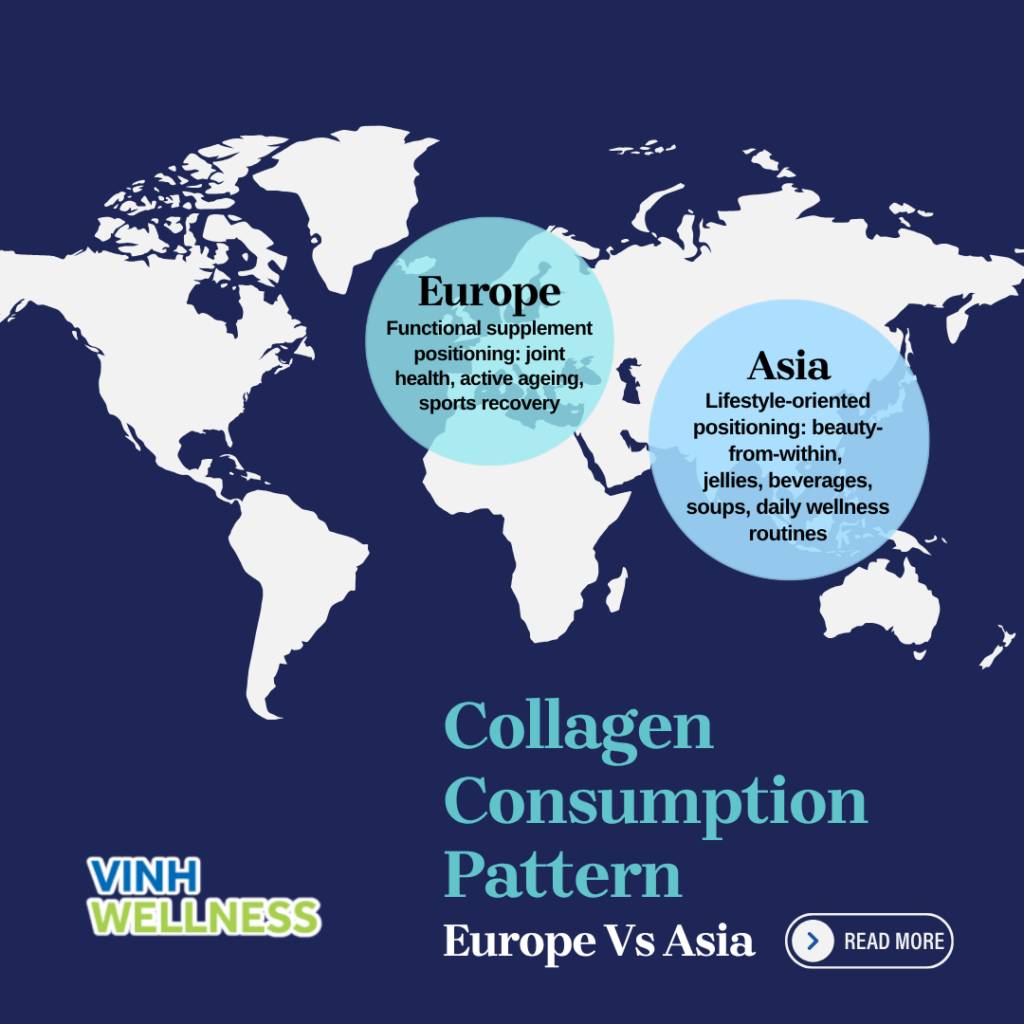
In Europe, collagen is firmly positioned within the health and wellness category. Consumers reach for collagen primarily for joint support, skin health, and sports recovery. The framing is clinical and functional rather than beauty-led.
Dominant formats include capsules and tablets, hydrolysed collagen powders, and functional beverages. Food-format innovations, jellies, shots, soups — remain comparatively rare in mainstream European retail.
On the regulatory side, EFSA takes a rigorous approach to health claims. No collagen-specific claims have been approved under the EU Nutrition and Health Claims Regulation. Brands must frame messaging carefully, often relying on approved claims for associated nutrients like vitamin C, or limiting language to general wellness. For ingredient suppliers, this shapes exactly what documentation buyers expect: clinical substantiation, EFSA-aligned dossiers, and conservative claim frameworks.
Consumer education on collagen specifics, molecular weight, peptide type, bioavailability remains relatively limited in the mass market. Most buyers know collagen for skin and joints; fewer understand the technical differences between types.
The Asian Collagen Market: Beauty-From-Within Leads
In Asia, particularly Japan, South Korea, and China, the market is more mature, more diverse, and driven by a different primary motivation: beauty from within. Collagen is not a niche wellness supplement here; it is a mainstream beauty and lifestyle product.
This cultural orientation has produced a very different format landscape. Collagen appears in single-serve drinks and shots, jellies (a format almost absent from European retail), soups and broths, and even snacks and confectionery. These formats demand different ingredient specifications, solubility, taste neutrality, heat stability, that not all collagen ingredients can meet.
Regulatory systems like Japan's FOSHU and FFC frameworks allow more nuanced functional claims than EFSA, provided appropriate evidence is filed. This gives brands more room to communicate specific benefits, and gives consumers more to expect.Asian consumers are also notably more sophisticated when it comes to collagen knowledge. Awareness of molecular weight and peptide size is mainstream in Japan and increasingly common across China and South Korea. Sourcing fish versus bovine is a real purchase decision factor. Ingredient suppliers entering these markets must be prepared for technically demanding buyers.
What This Means for Ingredient Buyers?
These aren't just interesting market observations. They have direct strategic implications.
Format prioritisation. For European markets, optimise for capsule fill, powder blending, and beverage stability. For Asia, invest in solubility testing for jelly and RTD formats, and assess heat stability for food applications.
Claims substantiation. Europe requires conservative, EFSA-aligned claims. Asia rewards specific, evidence-backed communication around peptide type, molecular weight, and bioavailability. Budget your clinical and regulatory resources accordingly.Market entry sequencing. Asia offers faster adoption, higher consumer education, and more format flexibility, but requires strong regulatory navigation and local market knowledge. Europe offers a more conservative but potentially more defensible position for clinically-substantiated ingredients. Neither is better, but the sequence matters.
Conclusion
The collagen opportunity is real in both markets. But it is not the same opportunity. European markets reward substantiation, conservative positioning, and supplement-format excellence. Asian markets reward food-format innovation, clear technical communication, and beauty-from-within alignment.
Ingredient suppliers who treat these as a single market will underperform in both. Those who understand the divergence , and build strategy around it, are the ones who will capture disproportionate share as the category grows.To explore our collagen ingredient portfolio and discuss formulation requirements for your target market, get in touch with the Vinh Wellness team.
https://www.vinhwellness.com/contact-us/
#CollagenEurope #CollagenAsia #VinhWellness #FormulatorsOfLinkedIn #BeautyFromWithin #FunctionalIngredients #GlobalFormulation
References:
1) European Commission — EU Register of Nutrition and Health Claims Official register confirming no approved health claims for collagen under Regulation (EC) No 1924/2006.https://ec.europa.eu/food/food-feed-portal/screen/health-claims/eu-register
2) EFSA — Scientific Opinion on Collagen Hydrolysate and Maintenance of Joints (2011) EFSA's published opinion on a collagen health claim submission, illustrating the rigour of the substantiation process. https://efsa.onlinelibrary.wiley.com/doi/pdf/10.2903/j.efsa.2011.2291
3) Japan Ministry of Health, Labour and Welfare — Food with Health Claims (FOSHU) Official government overview of Japan's FOSHU functional food regulatory framework. https://www.mhlw.go.jp/english/topics/foodsafety/fhc/02.html
4) Japan Consumer Affairs Agency — Foods with Function Claims (FFC) Overview of Japan's FFC system, the less stringent and increasingly popular route for functional claims. https://www.caa.go.jp/en/
5) Grand View Research — Global Collagen Market Report Market sizing and regional share data, including Europe's dominant 35% market share in 2024 and hydrolysed collagen growth projections. https://www.grandviewresearch.com/industry-analysis/collagen-market
6) Straits Research — Collagen Market Size and Growth Supporting data on global collagen market valuation and CAGR forecasts through 2033. https://straitsresearch.com/report/collagen-market
7) Nutrition Business Journal — for supplement format dominance data in European markets
https://store.newhope.com/collections/reports
8) Mintel Global New Products Database (GNPD) — for the product format comparison between Europe and Asia (jellies, RTDs, soups)
https://www.mintel.com/products/gnpd/